Monday, February 29, 2016

"The Eddie" Hawaii 2016

Image result for eddie would go bumper stickerWhen we first visited the Big Island in 2011, we noticed a bumper sticker that said "Eddie Would Go" and found it so intriguing we had to find out more.  What we found was not just the story of one amazing man -- but a deeply moving story about Hawaiian heritage and culture. (We are writing this mostly for folks back on the mainland who may know nothing about this event, person or cultural history.) 

As one of the most respected names in surfing, "Eddie" (Edward Ryon Makuahanai Aikau May 4, 1946 – March 17, 1978) was the first lifeguard at Waimea Bay on Oahu, saving many lives. He also was the first lifeguard to work the North Short where, during his watch, not a single life was lost.

Hokule'a
"Eddie" became involved in perpetuating his Hawaiian heritage. In 1976, the Polynesian Voyaging Society sailed the Hokule'a on a successful 30-day, 2500 mile journey following the ancient route of the Polynesian migration, using celestial navigation, between the Hawaiian and Tahitian islands. In 1978, a second voyage of the traditional sailing canoe was planned. At 31 years of age, Aikau was selected for this voyage as a crew member.

 John John Florence of Hawaii (pictured red) riding a monstrous wave alongside Mason Ho of Hawaii (black) during Round 2 of the Quiksilver in Memory of Eddie Aikau at Waimea Bay on Thursday February 25, 2016. Florence went on to win the event with the highest score across two rounds of competition. © WSL/ Keoki
We held our collective breath -- watching these 60 foot waves!
The Hokule'a left the Hawaiian Islands on March 16, 1978. The double-hulled voyaging canoe developed a leak in one of the hulls and later capsized in stormy weather about twelve miles south of the island of Molokai. In an attempt to get to land to save his crew and the Hokule'a, Aikau paddled toward Lanai on his surfboard. Hours later a commercial airplane spotted the Hokule'a and the rest of the crew was soon rescued by the U.S. Coast Guard. Aikau was missing at sea. Despite great search efforts "Eddie" was never seen again.

Held at Waimea Bay, "The Eddie" sponsored by Quicksilver, has not happened in many years because the conditions have to be perfect -- HUGE waves -- and the worldwide competition is by invitation only. For SEVEN years the waves have not been good enough to be called "The Eddie" but just last week we were blessed with stunning waves, rides and wipe outs.

CLICK LINK TO SEE LIVE SHOTS (hold your breath!) Quick Silver In Memory Eddie Aikau

CLICK LINK TO LEARN MORE ABOUT THE POLYNESIAN VOYAGING SOCIETY AND "HOKULE'A" :  Hokule'a Voyage

(The info here has been edited from a variety of sources including Wikipedia, Eddie Aikau Foundation, and other articles.)

Saturday, February 20, 2016

Lava "Burps" and Archaeology

Our first view --- long overgrown driveway
For the last couple of weeks I have been working (in between other projects) on a lava feature that materialized only last fall, when we had a bobcat operator clear back wide spaces on each side of our long driveway that were thick with invasive species, brittle junk trees, and mats of various vines and small shrubs. 
Me - poser/dozer for my Birthday!

(Here's a photo we took in 2012 when the front ½ acre was totally overgrown.)

As the bobcat work cleared the debris, we discovered we had a large, tall, intact flow of pahoehoe that at one time had flowed diagonally across the property.

Carefully cleaning dirt out of the cracks
Since the initial clearing took place a few months ago, this “high ground” has tempted me to uncover its secret face. For a solid week my first task was removing small bushes, debris and vines… down to dirt.  As I removed buckets and buckets of dirt, I began to see the ‘face’ of the pahoehoe that had flowed across the driveway – long before there was one. 

It was clear to me that using the pick ax would damage the beautiful unbroken lava flow, so I had to switch tools!  I got out a small triangle hand trowel and stiff brush and began the “lava archaeology” that eventually revealed beautiful swirls, folds and features all across the width of this 5 x 20’ outcropping.  As I patiently cleaned and brushed away the dirt it seemed very personal -- like a wrinkled face; the more I looked the more I saw.  (to SEE more - click on each photo)


Our house is way in the back
Heavy black shows 1955 "burps" and flows
Because this feature is 10-12 feet higher than the rest of the property, I began to wonder when this outcropping happened.  I found a USGS map that features more recent lava flows along Kilauea’s East Rift Zone in the Puna District on the Big Island of Hawaii.  There were some very late outbreaks (burps) that happened  as recently 1955.  We doubt our outcropping is that old, but it is still a reminder of how very young this island really is. 


Tuesday, February 16, 2016

It's STILL All Right Here!!

Art by Donna Seller - "Arts Alive in Old Town"
...now, though, the "here" is in PUNA Hawaii!

We spent 22 years living in the heart of Northern California’s redwoods where we also owned a successful gallery in the historic Old Town section of Eureka.  The slogan for this Victorian area was “It’s All Right Here.”  We enjoyed being able to say that everything we needed was on “our street” which was F Street. We lived in a charming old home on F Street that was built in the 1860’s.  Our business, Many Hands Gallery Many Hands Eureka  (pictured above left) was on F Street, as was our bookkeeper, hairdresser, bank, favorite restaurants and other amenities.  It was one of the real charms of living in a small community.

Lava approaching Pahoa Village Road

When we bought our retirement house in the Puna District on Hawaii’s Big Island, we soon discovered that we had delightedly moved to a similar situation in Pahoa.  We are retired so we no longer own a business.  However it is STILL “All Right Here” – on Pahoa Village Road where we find our bank, CPA, market, video shop, auto repair, drugstore, health food store, post office, senior center, library, chiropractor, swimming pool and numerous small novelty shops, museum and used bookstore. 


Because of Kilauea's serious lava flow from the Pu'u O'o vent that threatened to go right through the middle of Pahoa, we now have many aerial images of Pahoa Village that did not exist prior to that distressing year-long event.  (In case you didn’t know, the flow stopped just before Pahoa Village Road.)

For a couple local tours visit this U-Tube video. Photo Tour of Pahoa  OR Another Puna Tour -- Look see!


Saturday, February 6, 2016

Spider Webs and Galaxies

In Puna driving toward Pohoiki down Mango Road


Early one morning last week, my girlfriend Jan and I hopped in the car for a 12 minute ride down for a swim at one of Puna's favorite places on Hawaii's Big Island.

Wearing suits, sarongs and sandals and riding with car windows wide open we passed through the mile long sylvan tunnel locally known as “Mango Road” where branches of the ancient mango trees glowed in the morning sun. While rays of light flickered through the rich dark green canopy cool lavender shadows laced the underbrush.

As we both enjoyed the magic light, we were suddenly and simultaneously stunned at an unusual sight. There in the high treetops of the overarching branches were hundreds of spider webs, like galaxies, tilted at every angle, backlit by the sunlight and prisms of rainbows.  With the car fully stopped in the middle of the one-lane road, we were awestruck and silent. And we both also knew that when the light changed the vision we witnessed would be gone – gone in the way such ephemeral things vanish.

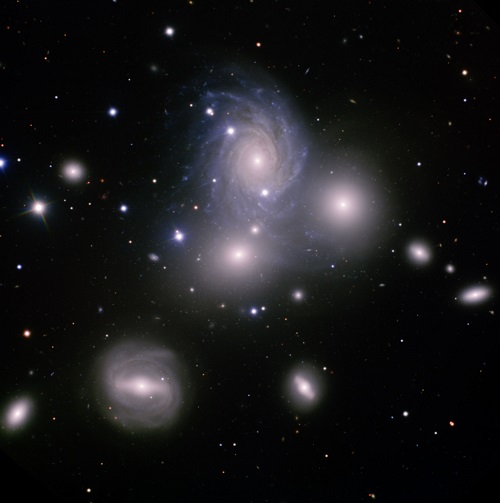
Gemini Legacy image of the galaxy "herd" VV 166
Even so, the next day, I spent an hour finding that same spot – a near impossibility on that stretch of tree-lined roadway.  Ready to give up my walking back and forth with stretched neck muscles, I turned around one last time – and THERE THEY WERE!  Of course I took photos, none of which begin to capture what Jan and I saw, or even what I saw the following day. I was very much reminded of galaxies in deep far reaches that are like spider webs woven in space.  In fact, there is actually a cluster of galaxies that are called “The Spiderweb.”

We are especially excited to share a BRAND NEW image with you from GEMINI Observatory taken right here from Mauna Kea!!!  Here is a quote that tells a little about this image.

A compelling new image from Gemini Observatory peers into the heart of a group of galaxies (VV166) traveling through space together. The variety of galactic forms range from a perfect spiral, to featureless blobs and present, at a glance, a sampling of the diversity and evolution of galaxies. Galaxy groups important laboratories for studying how galaxies form and evolve beyond our own Local Group of galaxies, which includes the Milky Way and the Great Spiral in Andromeda. Unlike animal herds, which are generally the same species traveling together, most galaxies move through space in associations comprised of myriad types, shapes, and sizes. Exploring the nature of these extragalactic “herds” may help to unlock the secrets to the overall structure of the universe.


Sunday, January 31, 2016

Moonlight (Malamalama o ka mahina)

While waiting for the moon to rise -- here's my view (while floating)

Phil and I are attending a weekly Hawaiian language class for beginners. The purpose is not to learn to speak fluent Hawaiian, a rich complex language that is very much alive and taught early to children attending local schools. Our goal is to learn what we can, so we may more fully appreciate the highly conceptual nature of this language, where for example, the word aloha means about 15 different things!

Moonlight on the water
Image result for Hawaiian navigation starsImage result for Hawaiian navigation starsMalamalama o ka mahina means moonlight in Hawaiian. Malamalama is also the name for a local school because this word also means light of knowledge. Lama means torch, lamp or light.  Each month for the full moon we make a trek down to the ocean to watch to moon rise over the water. The drive down at night is dark -- there are no street lights as we head due east from our house. Nor is the area where we swim lighted, so flashlights are essential. This last full moon we arrived about 45 minutes early, so it was very dark and the stars were brilliant.

It is absolutely delightful to walk down the well-worn lava steps and slide into the warm dark water at Ahalanui Park. Since I swim there several times a week, I know where all the edges of the large pool are and how to navigate in the dark. Just floating in the water under the stars is beyond magical.  This photo is exactly what I saw this visit. Then, as the moon rises, the eastern sky begins to lighten with moonlight playing tricks with the clouds. Moonlight also plays across the waves as they pile up and crash over the sea wall of the pool.

The ancient Polynesians navigators made their way to many isolated islands in the Pacific Ocean by celestial navigation -- using star "lines."  Currently the Polynesian Navigational Society is conducting a three-year voyage round the world using star charts like the one we have included here.

Two hand built voyaging canoes Hokule'a and Hikianalia, are traveling over 60,000 nautical miles around the world.  We encourage you to learn more about this amazing voyage by clicking on this link: Polynesian Voyaging Society .


Friday, January 22, 2016

Phil and the Hawaiian Hawk

Full height of sculpture
Phil's painting
We moved into our house in Puna on the Big Island in December 2012. Only a few weeks later we were surprised to be visited by two hawks who landed in our very own Ohia trees. One was a light colored one, and one was a brown one.  (There is a little Hawk Info at the bottom of the blog.)

Phil, inspired by this auspicious visitation, headed right for his watercolors. The painting is done from a real photograph that Phil took himself -- the hawk lifting off from a branch. Now that we have been here a few years, we notice the pattern of them returning here during the early part of the year; they nest around March.  "CLICK" on any photo for a close-up view.


Top of piece
Landing for a viewing
Last year, we had to cut down some of our dying Ohia trees (from a fungus scientists are still attempting to understand -- and which threatens the entire Ohia population on the Big Island.) We asked the tree fallers not to cut them at the ground, but to leave 8-10 feet standing -- so Phil could think about what kind of sculpture he might create from the remaining trees.  We built up a platform for him to stand on because the surrounding ground was full of loose chunks of lava.

Over a period of months, he began to envision carving and purchased a cute little 12" chain saw to work with.  Last week as he was completing the first one, he kept feeling that what he had been doing somehow connected him to the earlier hawk visitations.  As he was finishing the final work on the sculpture at the end of the day, a light-phase hawk flew down and landed in some bare branches just behind the sculpture.  That settled it in his mind -- we are talking with a language teacher to determine just how to name the piece -- in honor of the fact that hawks represent ancestors to native Hawaiian people.
Finished piece is on the left -- new one on the right

Now that this piece is completed, the final photo is of Phil securely screwing down the rotating platform around the base of his next carving project.
-------------------
INFO ABOUT HAWAIIAN HAWK
The ‘io (pronounced EE-oh is endemic to Hawai‘i and was a symbol of royalty in Hawaiian legend. The ‘io is also the only hawk today native to Hawai‘i. They only breed on the Big Island. Although there is one species it comes in two “phases” – two distinct colors – light cream and brown.  They have a shrill and high-pitched call much like their Hawaiian name: "eeeh-oh."  They depend on native forest for nesting, but are able to use a broad range of habitats for foraging, including papaya and macadamia nut orchards, as well as forests dominated by native and introduced vegetation, from sea level to 6,500 feet elevation. 


Sunday, January 17, 2016

This Week's Colors

6am light at property corner
One of the most magical aspects of  living in Hawaii during the winter months is the unusually low sun angle. Here at 19.5 degrees latitude, in Pahoa on the Big Island, the winter solstice light is rare, like waves of particles in a spectral dance.The sun rises low with a golden glow at the back corner of our property. Although you can't see it in the photo, a bright pink ribbon circles that center tree marking our property line.

With less words and more pictures this entry, just enjoy the vibrant colors we enjoy every day.
.
These are a few our regular geckos 

Violet blue flowers frame by Ti plants, Monarch butterfly laying eggs on the Crown Flower plant, scenes from the island's edge -- tidepools* at MacKenzie Park, roots* of Ironwood tree, and a favorite winter fruit -- Rambutan.

Remember, you can "click" on any of the small photographs to have a bigger/better view.


 (* 2 Photos taken by my friend Catherine and creatively adapted by me using PhotoShop.)


Wednesday, January 13, 2016

This Week's Wildlife


If you are a regular blog follower, you'll know that last week's wildlife story featured a show-down between "Team Corgyn" and a mongoose -- a pest especially prevalent here in Puna's thick forest and jungle.  Another wildlife creature we deal with, especially in the winter months, are Norwegian RATS!!

Emptying and resetting traps daily is part of our winter maintenance, faithfully administered by Phil.  So far this winter, our rat catch is up to over 20!

Rats originally got to the islands on 18th and 19th century sailing ships.  Once here, where they had no natural enemies, they flourished on the islands.  Since they are voracious eaters, they began to decimate the cane and pineapples fields, so the local American and European landowners imported Asian mongoose to kill them.  The only problem is that the rats are up at night and the mongoose are active during the day.  Now we have two pests!

Paul's Repair sent us this photo
Last week as we drove the truck for the weekly recycle and dump run, we notice the the fan made a rhythmic clacking sound -- similar to the sound made when we paper clipped cards to the spokes of our bikes as kids. We dropped the truck off a couple days later at our local auto repair guy who immediately suspected a rat nest.  And, sure enough, within an hour, he emailed us the following photo -- and said the filter and fan were clean and ready to go.

Ehu
These prevalent rat episodes reminded us of a great story by a friend of ours whose stories in pidgin are well known and appreciated locally.  We met Jozuf Hadley in 2011 -- a year before we bought our house.  "Bradajo" as he is known locally, tells the story of the neighbor's cat "Ehu" who visits his house to catch rats -- and they all end up with a colorful encounter.  Hope you'll take time to click on this link to hear the story. Bradajo's "Ehu and da rat" story   (PS if you are new to Hawaiian Pidgin, you may need to listen again...but it is worth it.)


Sunday, January 10, 2016

New Year View

One of our two "Firecracker" Trees
When we first moved into our new hale (house) in the Puna district on the Big Island, it was winter. We celebrated our first Christmas and New Year in a empty house waiting for the container to arrive with all our earthly possessions.

Straight behind Phil -- is due West
As we explored our new territory we noticed one particular tree that had a profusion of white and pink flowers blooming just in time for New Year. Not surprising, its common name was "Firecracker Tree."   We managed to find two small starts and planted them in the front yard.

Today was the perfect day for a chore we have put off since the end of October when we switched the heating of our hot tub from electric to solar.  (You can visit our 10/28/15 blog for that story -- link to story --  Using SUN power! )  In any case, we knew that the 500 feet of sun-heated irrigation hose would be more efficient IF the roof was painted black.


Today, with good cooling breezes right off the ocean, we hoisted up a gallon of paint to finish the job.  We shifted all the coils of hose to one side, painted, and then shifted them the other way to get the other half. While up-top on such a beautiful day, we decided to take and share a few pictures of what our surrounding forest looks like from that view.

View to North
View to South

After finishing the task, Lunel decided it would be a good idea to paint ALOHA on the roof -- for low flying space craft carrying aliens who may want to make contact with friendly locals.

Enjoy the VIEWS!!  (You can click on the images, like Lunel's ALOHA Aliens sign, to make it bigger.)


Wednesday, January 6, 2016

Corgi Tug-of-War

"Poko" making the challenge
Recently I had my first colonoscopy and was fortunate to have a rousing referral to a well-liked gastroenterology doctor whose team made the experience a good one.  Really!  The staff at the surgery center was great -- and as part of their patient care, they provide cute purple socks to all the patients.
3-way tug-of war

If you live with corgi dogs, you soon learn that things "on the floor" are considered fair game, whether that is candy wrappers, desiccant bags (yes, Lani recently ate one) or purple socks.  So it came as no surprise when Poko nabbed one and challenged the girls to a game of tug-of-war.  Days later both socks were shredded.

The "Mighty Hunters"
Now, the other picture is one you probably don't want or need to see.   Yet, it IS part of rural living in Puna on the Big Island!  Two days ago, while I was working on the new driveway lava beds, I noticed a commotion and when I looked, Team Corgyn had captured a mongoose and were excitedly tossing it up in the air -- a volley to the next team member. As I headed to the scene, I witnessed a quick "snap" that broke it's neck so it's end was at least quick. Reaching the ruckus, however I could see more fun was in store as the game strategy quick shifted to another favorite game (yes, you guessed it) tug-of-mongoose.

Smart dogs that they are, they responded quickly to the command "Put it DOWN!" so we were able to avoid the dreaded and bloody "drawn and quartered" scene and the body was appropriately dispatched.  They were, however, understandably proud of themselves and suggested that their escapade as "Mighty Hunters" would make a good post for the blog.  Being the doting parent, of course, it was easy to comply...however, I decided the death grip would be most appropriately represented by a cartoon.


Saturday, January 2, 2016

New Year Trees

Yesterday we celebrated the 
New Year in Puna style!

First, a early morning swim down at Ahalanui. Next, picking two baskets full of limes, lemons, lilikoi, oranges, tangerines and tangelos to make several quarts of juice from our mini orchard.  Some juice we freeze into ice cubes, but some is so delicious it's gone in a couple days.

This long slope is about 66 feet in length


Phil did some weed whacking around the edges keeping us neat and trim.

Lunel continued work on the slope (66' feet long*) that runs the length of the driveway...converting it into tiered beds with lava walls.   *Measured and corrected

This long slope was originally created when the big D9 cat created the driveway -- busting through yards of lava.  The loose broken lava was pushed to the side creating the slope.

Deconstruction of the slope provides the raw materials needed to create the tiered lava beds.

After lunch we decided that planting trees was a good way to issue in the new year.  Using deep holes dug previously, we selected and planted three of our forest trees we have been nurturing.

To all of our blog followers, we wish you a HAPPY NEW YEAR!  
 Thank you for following our adventures on the Big Island!

The 1st quarter of the slope is completed
Inspectors check out progress on the 2nd quarter