Showing posts with label Polynesian Navigation. Show all posts

Tuesday, October 5, 2021

STARS OVER HAWAII


When we retired and moved from California we were familiar with the constellations like Orion, Cassiopeia and so forth like this image (left)  

Because of our array of telescopes atop Mauna Kea, the island has very low lighting which means we do have excellent star scapes.

However, the star chart for Hawaii is very different. Early Polynesian navigators used four distinct “Star lines” to navigate  cross thousands of ocean miles.                                                                  


The Hawaiian names are, of course, in the Hawaiian language and translated they are: Kite of Kawelo and the Fish hook of Maui which can be seen in the fall and winter sky (shown below.) During winter/spring and spring/summer the star lines seen are named The Bailer and the Backbone

At Imiloa Astronomy Center in Hilo on the Big Island, lectures and special events offer educational opportunities to learn about Hawaii’s legacy of exploration.

 Imiloa Astronomy Center Hilo


The star line pictured here is called “The Backbone” -- one that is easier for us to see because it includes several more familiar constellations. It is Seen during the spring and summer months

For more information about star lines:

Hawaii Navigation by the Stars


Sunday, January 31, 2016

Moonlight (Malamalama o ka mahina)

While waiting for the moon to rise -- here's my view (while floating)

Phil and I are attending a weekly Hawaiian language class for beginners. The purpose is not to learn to speak fluent Hawaiian, a rich complex language that is very much alive and taught early to children attending local schools. Our goal is to learn what we can, so we may more fully appreciate the highly conceptual nature of this language, where for example, the word aloha means about 15 different things!

Moonlight on the water
Image result for Hawaiian navigation starsImage result for Hawaiian navigation starsMalamalama o ka mahina means moonlight in Hawaiian. Malamalama is also the name for a local school because this word also means light of knowledge. Lama means torch, lamp or light.  Each month for the full moon we make a trek down to the ocean to watch to moon rise over the water. The drive down at night is dark -- there are no street lights as we head due east from our house. Nor is the area where we swim lighted, so flashlights are essential. This last full moon we arrived about 45 minutes early, so it was very dark and the stars were brilliant.

It is absolutely delightful to walk down the well-worn lava steps and slide into the warm dark water at Ahalanui Park. Since I swim there several times a week, I know where all the edges of the large pool are and how to navigate in the dark. Just floating in the water under the stars is beyond magical.  This photo is exactly what I saw this visit. Then, as the moon rises, the eastern sky begins to lighten with moonlight playing tricks with the clouds. Moonlight also plays across the waves as they pile up and crash over the sea wall of the pool.

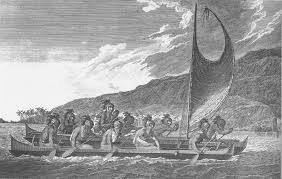
The ancient Polynesians navigators made their way to many isolated islands in the Pacific Ocean by celestial navigation -- using star "lines."  Currently the Polynesian Navigational Society is conducting a three-year voyage round the world using star charts like the one we have included here.

Two hand built voyaging canoes Hokule'a and Hikianalia, are traveling over 60,000 nautical miles around the world.  We encourage you to learn more about this amazing voyage by clicking on this link: Polynesian Voyaging Society .


Wednesday, June 25, 2014

Koa'e Kea

White-Tailed Tropicbird or Koa'e Kea
Phil beautiful "Koa'e Kea" piece today at One Gallery in Hilo.  It was inspired by the navigational star chart used by the Polynesian Navigational Society.

He had this beautiful piece of Koa wood in his wood shop and knew there was a bird shape in it, but it took several weeks to bring the whole piece into being.  It is mounted on Mahogany.  This is his interpretation of the star chart that features 32 points associated with stars.

It is really quite interesting that Phil's mother, Margaret at age 96, left on her Final Voyage on the same day that the Wa'a (traditional Polynesian sailing vessels) Hōkūle‘a and Hikianalia left from Hilo on their three year round the world voyage.  This week, they arrived In Tahiti...10 days early.


The Mālama Honua Worldwide Voyage will visit 85 ports and 26 countries, including 12 of UNESCO’s Marine World Heritage sites, through June 2017. The first stop for Hōkūle‘a and Hikianallia is Tahiti, where Hōkūleʻa made her first voyage in 1976. The voyage is made possible by many community sponsors and partners, including Hawaiian Airlines, the University of Hawai‘i, Kamehameha Schools, the James and Abigail Campbell Family Foundation, the Office of Hawaiian Affairs, and many more.

To read more about this amazing journey, please go to this link:
Polynesian Voyaging Society