Monday, March 28, 2016

Planting Ohia Trees for Easter

Ohia ready to plant (generator shed behind them)
Nearly three years ago we met a neighbor who was planning to put in a driveway where many baby ohia trees were growing.  We were able to rescue about a dozen small ohia trees, getting them into pots for future planting.

After doing so, we were told "ohia trees don't like to be moved -- and their roots are very sensitive." We figured they would have no chance at all left where they were.  For the past three years we have been caring for them in their temporary pots, hoping for the best. Two years ago, we began to transfer them into deep holes fortified with compost and have had 100% success.

In 2014 when the traditional Polynesian double-hulled voyaging canoes (Hokule'a and Hikianalia) left for their world-wide tour, we chose to plant baby ohia trees. (For more info about Hokule'a go to this link:  Hokule'a  When Phil's mom died, also in 2014, we planted ohias in her honor.

A year ago as more was being discovered about the dying Ohia trees, I wrote a poem to express my own sadness.

“Silent Death”

Creeping slowing, striking swift.
One by one they wither -- 
Whether or not we see it.

Down the street, across the way, 
Silent death approaches.

Treetops against the sun, 
Not noticeable at first --
Until half-way down,
the sickness run.

In so few days first one
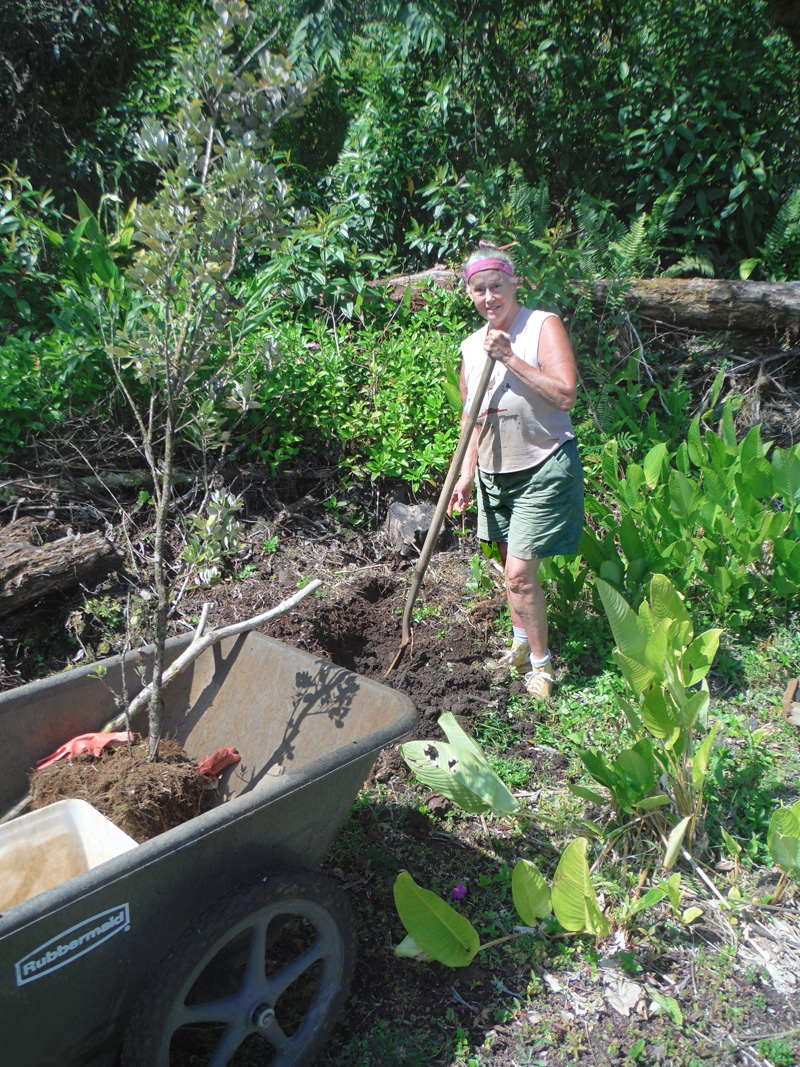
Easter -- digging holes for Ohia trees
Then another is gone -
No leaves, no life.
It is done.

Silent killer, but no
Reason found --
In the air or
On the ground.

No more home to bugs and birds,
They stand denuded and bare.
Such sadness can
Hardly find the words.

Ancient strong Ohia bold --
Sweet lovely Lehua old --
Are we to blame?
Is this our shame?

Lunel

August 2015

Friday, March 25, 2016

Spring Equinox

The other evening the sky was so dramatic Phil went outside around 5:30 pm, camera in hand, and took two photos both within a minute of each other. The mackerel clouds covered the whole sky and the moon was nearly full.  The first photo (left) was facing due east and the rising moon and the second one was taken looking due west down our long driveway.

When we first moved to the Big Island's Puna District in 2012 everyone on The Continent thought we must have palm trees and white sand beaches. " No," we would explain.  "We live in an ohia forest!" Then, however we did not get this western view so low to the horizon.  Sadly, our neighbors across the street have lost nearly all their beautiful ohia trees**.  You can see some of the bare branches outlined by the brilliantly colored sky.


**If you don't know about our dying Ohia trees -- refer to our March 9th entry where there are links to stories about this sad disaster.  Hard sometimes to admit that life IS change.  Or, this newest article just put out by NPR (very sad) we live at "ground zero!)

Elegant solitary Lehua blossom over the bed of orchids
Bed of Nun's Cap Orchids (under Ohia tree)
Even the weather is changing!

As a result of our significant drought several weeks earlier in the year, this spring's bloom of Nun's Cap orchids and the Lehua blossoms on the Ohia trees are late -- but nonetheless beautiful.


Sunday, March 20, 2016

Building Lava Rock Walls (Intuitively)

For many reasons I have gone through most of my life trusting my intuition, mostly ignoring directions, and being willing to fail and learn from my own mistakes rather than first finding some book on the subject.  It never occurred to me until just today that I could find a book, let alone a U tube video to tell me how to build a lava rock wall.  (click on any photo to enlarge)


To find lava - start digging!
Flat blank canvas - our property (2012)
Today, after three years, I decided to look it up. When the first words were "get out your measuring tape" I knew I was in the wrong department.  When I saw that you started with the BIG rocks first, I realized I had spent three years of building them upside-down. Silly me?!?!   I begin with all the SMALL lava rocks first, stamping them firmly down to create a wide bed.  After a layer or two of medium rocks edged firming into place, I finish my walls with the big heavier stones that hold everything in place.  To my way of thinking, everything in the universe is built from the small stuff.

Stomp a firm foundation

Funny thing is, when we first moved to the Puna District on the Big Island and began to assess the very blank canvas of our one acre, there were no visible lava rocks on the flat terrain of crushed red cinder surrounding the house.  I ignorantly asked our next door neighbor where people got their lava to build with.  Typical of the kindness here, he did not laugh, and replied quietly, "You just have to start digging."  And so I did.

I have never allowed "not knowing" to stop me from learning, but in following my intuition, I decided that I would let the lava teach me what I needed to know.  I look at our first walls, and I smile; although they are not so good, they were my patient first teachers.  In fact the first word I learned in Hawaiian language was PO, as in POHAKU.

An "upside down" lava wall in progress.
PO has many meanings that include: night, darkness, realm of the gods.  Its deeper meanings also include a primordial deep darkness from which everything springs into being-ness. This certainly appealed to me as I appreciate the mythology surrounding the Sacred Darkness respected by many cultures around the world.

POHAKU means rock, stone, but lava stones here in Hawaii carry the spirit of the land in ways far to complex to enumerate here. Simply put, however, they are the foundation for the entire island culture that did not use metal -- used for building gigantic structures, for walls of homes and pens for animals, for scraping and cutting tools, weapons, catching fish in lava walled fish ponds, and preparing food. Working with them I feel an appreciation and I feel a quiet sense of grounding being here -- in this new-land-place.


Wednesday, March 9, 2016

Planting Ironwood Trees


Graceful Ironwood Tree at MacKenzie Park on the Big Island
Today we planted three Ironwood trees.  During the last six months, we have been slowly and sadly replacing our dead Ohia trees and still have about eight other varieties to plant.

(If you don't know about this ecological tragedy, you can read about it at this link:  Dying Ohia Trees.    Or, Possible cause:  Beetle Spreading Fungus?

This week we narrowed down the right places for our three Ironwood trees that each came from different places on our Big Island.

The first one we found uprooted down at MacKenzie Park in an area known as Opihikao.  It is one of our favorite places along the famous “Red Road” here in Puna. During Hurricane Iselle in 2014, the park was hit hard by Hurricane Iselle that swept ashore pulling trees right out of the ground.

The Park is name for ranger Albert MacKenzie who planted many of the ironwood trees that cover the 13 acre park.  The "Casuarina" trees were brought to many islands as seeds, floating on logs or pumice.   The park has a fascinating history including prison convicts, King Kamehameha's Highway, and ghost stories.  (CLICK on this for great stories! MacKenzie Park )

The park is 20 minutes from our house along "Red Road"
"Take me home with you."
We purchased the second Ironwood tree months ago as one replacement for some of our dying Ohia trees. And, just this last week we found a third one in a very unexpected place.

We were running an errand, with our Tundra truck, to pick up a load of volcanic red cinder that's being quarried right from a volcanic cinder cone a few miles from our house.  This tiny tree (with three small trunks) was pushing its way up through a pile of red cinder the size of a house and it looked like it needed a new home.


Wednesday, March 2, 2016

Marching into March

YELLOW is rainfall for 2016 - so far
This blog entry is a little potpourri of the last week or so.  Although it is hard to imagine Hawaii having a drought, it is true -- and we are feeling it here in Puna on the Big Island! Just look at this rain chart and you will see how badly we need rain -- just like our friends back on the mainland.  Last year's January and February were both dry, but this year has been even worst.


Sunday we attended a presentation by our local Lelani Hula Halau which has been offering classes here in Leilani for many years under the guidance of their kumu (teacher) who was able to come and see them on Sunday.

Here is a lovely photo of them gathered just after the performance. They were accompanied by PUKA (Puna 'Ukulele & Kanikapila Association.) Kanikapila is a style of Hawaiian music that is impromptu, like a jam session, that would typically take place at the beach or a family gathering.

PUKA at local Pahoa Parade
"But Mom, where's her tail?"
The annual Westminster Dog Show happened a few days ago too. Of course we all watched together as a family.  We feel the corgi dogs are often given the short end of the stick (no pun intended).  POKO (standing) had a crush on this year's entry -- a sweet little girl corgi named "Annie Oakley."

And finally, this week we uncovered yet ANOTHER buried vehicle -- this makes the third!  Early on we found one up near the front of the property -- a tire and part of a chassis.

Next we found disparate chunks of a classic old blue hippie van and used parts of it in yard art.  Now we have uncovered part of a yellow bus -- and while it may be the perfect pairing with the old van, we hope this represents that last of the vehicle archaeology!!


Monday, February 29, 2016

"The Eddie" Hawaii 2016

Image result for eddie would go bumper stickerWhen we first visited the Big Island in 2011, we noticed a bumper sticker that said "Eddie Would Go" and found it so intriguing we had to find out more.  What we found was not just the story of one amazing man -- but a deeply moving story about Hawaiian heritage and culture. (We are writing this mostly for folks back on the mainland who may know nothing about this event, person or cultural history.) 

As one of the most respected names in surfing, "Eddie" (Edward Ryon Makuahanai Aikau May 4, 1946 – March 17, 1978) was the first lifeguard at Waimea Bay on Oahu, saving many lives. He also was the first lifeguard to work the North Short where, during his watch, not a single life was lost.

Hokule'a
"Eddie" became involved in perpetuating his Hawaiian heritage. In 1976, the Polynesian Voyaging Society sailed the Hokule'a on a successful 30-day, 2500 mile journey following the ancient route of the Polynesian migration, using celestial navigation, between the Hawaiian and Tahitian islands. In 1978, a second voyage of the traditional sailing canoe was planned. At 31 years of age, Aikau was selected for this voyage as a crew member.

 John John Florence of Hawaii (pictured red) riding a monstrous wave alongside Mason Ho of Hawaii (black) during Round 2 of the Quiksilver in Memory of Eddie Aikau at Waimea Bay on Thursday February 25, 2016. Florence went on to win the event with the highest score across two rounds of competition. © WSL/ Keoki
We held our collective breath -- watching these 60 foot waves!
The Hokule'a left the Hawaiian Islands on March 16, 1978. The double-hulled voyaging canoe developed a leak in one of the hulls and later capsized in stormy weather about twelve miles south of the island of Molokai. In an attempt to get to land to save his crew and the Hokule'a, Aikau paddled toward Lanai on his surfboard. Hours later a commercial airplane spotted the Hokule'a and the rest of the crew was soon rescued by the U.S. Coast Guard. Aikau was missing at sea. Despite great search efforts "Eddie" was never seen again.

Held at Waimea Bay, "The Eddie" sponsored by Quicksilver, has not happened in many years because the conditions have to be perfect -- HUGE waves -- and the worldwide competition is by invitation only. For SEVEN years the waves have not been good enough to be called "The Eddie" but just last week we were blessed with stunning waves, rides and wipe outs.

CLICK LINK TO SEE LIVE SHOTS (hold your breath!) Quick Silver In Memory Eddie Aikau

CLICK LINK TO LEARN MORE ABOUT THE POLYNESIAN VOYAGING SOCIETY AND "HOKULE'A" :  Hokule'a Voyage

(The info here has been edited from a variety of sources including Wikipedia, Eddie Aikau Foundation, and other articles.)

Saturday, February 20, 2016

Lava "Burps" and Archaeology

Our first view --- long overgrown driveway
For the last couple of weeks I have been working (in between other projects) on a lava feature that materialized only last fall, when we had a bobcat operator clear back wide spaces on each side of our long driveway that were thick with invasive species, brittle junk trees, and mats of various vines and small shrubs. 
Me - poser/dozer for my Birthday!

(Here's a photo we took in 2012 when the front ½ acre was totally overgrown.)

As the bobcat work cleared the debris, we discovered we had a large, tall, intact flow of pahoehoe that at one time had flowed diagonally across the property.

Carefully cleaning dirt out of the cracks
Since the initial clearing took place a few months ago, this “high ground” has tempted me to uncover its secret face. For a solid week my first task was removing small bushes, debris and vines… down to dirt.  As I removed buckets and buckets of dirt, I began to see the ‘face’ of the pahoehoe that had flowed across the driveway – long before there was one. 

It was clear to me that using the pick ax would damage the beautiful unbroken lava flow, so I had to switch tools!  I got out a small triangle hand trowel and stiff brush and began the “lava archaeology” that eventually revealed beautiful swirls, folds and features all across the width of this 5 x 20’ outcropping.  As I patiently cleaned and brushed away the dirt it seemed very personal -- like a wrinkled face; the more I looked the more I saw.  (to SEE more - click on each photo)


Our house is way in the back
Heavy black shows 1955 "burps" and flows
Because this feature is 10-12 feet higher than the rest of the property, I began to wonder when this outcropping happened.  I found a USGS map that features more recent lava flows along Kilauea’s East Rift Zone in the Puna District on the Big Island of Hawaii.  There were some very late outbreaks (burps) that happened  as recently 1955.  We doubt our outcropping is that old, but it is still a reminder of how very young this island really is. 


Tuesday, February 16, 2016

It's STILL All Right Here!!

Art by Donna Seller - "Arts Alive in Old Town"
...now, though, the "here" is in PUNA Hawaii!

We spent 22 years living in the heart of Northern California’s redwoods where we also owned a successful gallery in the historic Old Town section of Eureka.  The slogan for this Victorian area was “It’s All Right Here.”  We enjoyed being able to say that everything we needed was on “our street” which was F Street. We lived in a charming old home on F Street that was built in the 1860’s.  Our business, Many Hands Gallery Many Hands Eureka  (pictured above left) was on F Street, as was our bookkeeper, hairdresser, bank, favorite restaurants and other amenities.  It was one of the real charms of living in a small community.

Lava approaching Pahoa Village Road

When we bought our retirement house in the Puna District on Hawaii’s Big Island, we soon discovered that we had delightedly moved to a similar situation in Pahoa.  We are retired so we no longer own a business.  However it is STILL “All Right Here” – on Pahoa Village Road where we find our bank, CPA, market, video shop, auto repair, drugstore, health food store, post office, senior center, library, chiropractor, swimming pool and numerous small novelty shops, museum and used bookstore. 


Because of Kilauea's serious lava flow from the Pu'u O'o vent that threatened to go right through the middle of Pahoa, we now have many aerial images of Pahoa Village that did not exist prior to that distressing year-long event.  (In case you didn’t know, the flow stopped just before Pahoa Village Road.)

For a couple local tours visit this U-Tube video. Photo Tour of Pahoa  OR Another Puna Tour -- Look see!


Saturday, February 6, 2016

Spider Webs and Galaxies

In Puna driving toward Pohoiki down Mango Road


Early one morning last week, my girlfriend Jan and I hopped in the car for a 12 minute ride down for a swim at one of Puna's favorite places on Hawaii's Big Island.

Wearing suits, sarongs and sandals and riding with car windows wide open we passed through the mile long sylvan tunnel locally known as “Mango Road” where branches of the ancient mango trees glowed in the morning sun. While rays of light flickered through the rich dark green canopy cool lavender shadows laced the underbrush.

As we both enjoyed the magic light, we were suddenly and simultaneously stunned at an unusual sight. There in the high treetops of the overarching branches were hundreds of spider webs, like galaxies, tilted at every angle, backlit by the sunlight and prisms of rainbows.  With the car fully stopped in the middle of the one-lane road, we were awestruck and silent. And we both also knew that when the light changed the vision we witnessed would be gone – gone in the way such ephemeral things vanish.

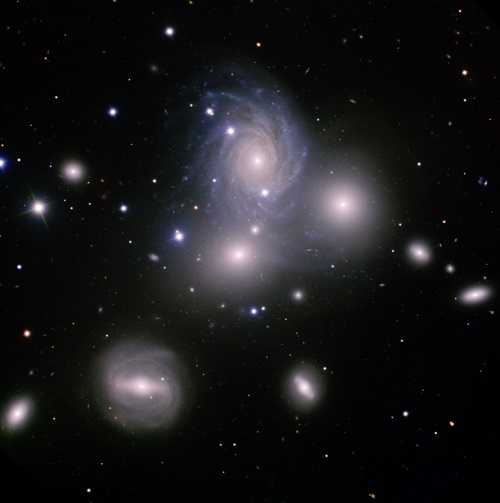
Gemini Legacy image of the galaxy "herd" VV 166
Even so, the next day, I spent an hour finding that same spot – a near impossibility on that stretch of tree-lined roadway.  Ready to give up my walking back and forth with stretched neck muscles, I turned around one last time – and THERE THEY WERE!  Of course I took photos, none of which begin to capture what Jan and I saw, or even what I saw the following day. I was very much reminded of galaxies in deep far reaches that are like spider webs woven in space.  In fact, there is actually a cluster of galaxies that are called “The Spiderweb.”

We are especially excited to share a BRAND NEW image with you from GEMINI Observatory taken right here from Mauna Kea!!!  Here is a quote that tells a little about this image.

A compelling new image from Gemini Observatory peers into the heart of a group of galaxies (VV166) traveling through space together. The variety of galactic forms range from a perfect spiral, to featureless blobs and present, at a glance, a sampling of the diversity and evolution of galaxies. Galaxy groups important laboratories for studying how galaxies form and evolve beyond our own Local Group of galaxies, which includes the Milky Way and the Great Spiral in Andromeda. Unlike animal herds, which are generally the same species traveling together, most galaxies move through space in associations comprised of myriad types, shapes, and sizes. Exploring the nature of these extragalactic “herds” may help to unlock the secrets to the overall structure of the universe.


Sunday, January 31, 2016

Moonlight (Malamalama o ka mahina)

While waiting for the moon to rise -- here's my view (while floating)

Phil and I are attending a weekly Hawaiian language class for beginners. The purpose is not to learn to speak fluent Hawaiian, a rich complex language that is very much alive and taught early to children attending local schools. Our goal is to learn what we can, so we may more fully appreciate the highly conceptual nature of this language, where for example, the word aloha means about 15 different things!

Moonlight on the water
Image result for Hawaiian navigation starsImage result for Hawaiian navigation starsMalamalama o ka mahina means moonlight in Hawaiian. Malamalama is also the name for a local school because this word also means light of knowledge. Lama means torch, lamp or light.  Each month for the full moon we make a trek down to the ocean to watch to moon rise over the water. The drive down at night is dark -- there are no street lights as we head due east from our house. Nor is the area where we swim lighted, so flashlights are essential. This last full moon we arrived about 45 minutes early, so it was very dark and the stars were brilliant.

It is absolutely delightful to walk down the well-worn lava steps and slide into the warm dark water at Ahalanui Park. Since I swim there several times a week, I know where all the edges of the large pool are and how to navigate in the dark. Just floating in the water under the stars is beyond magical.  This photo is exactly what I saw this visit. Then, as the moon rises, the eastern sky begins to lighten with moonlight playing tricks with the clouds. Moonlight also plays across the waves as they pile up and crash over the sea wall of the pool.

The ancient Polynesians navigators made their way to many isolated islands in the Pacific Ocean by celestial navigation -- using star "lines."  Currently the Polynesian Navigational Society is conducting a three-year voyage round the world using star charts like the one we have included here.

Two hand built voyaging canoes Hokule'a and Hikianalia, are traveling over 60,000 nautical miles around the world.  We encourage you to learn more about this amazing voyage by clicking on this link: Polynesian Voyaging Society .